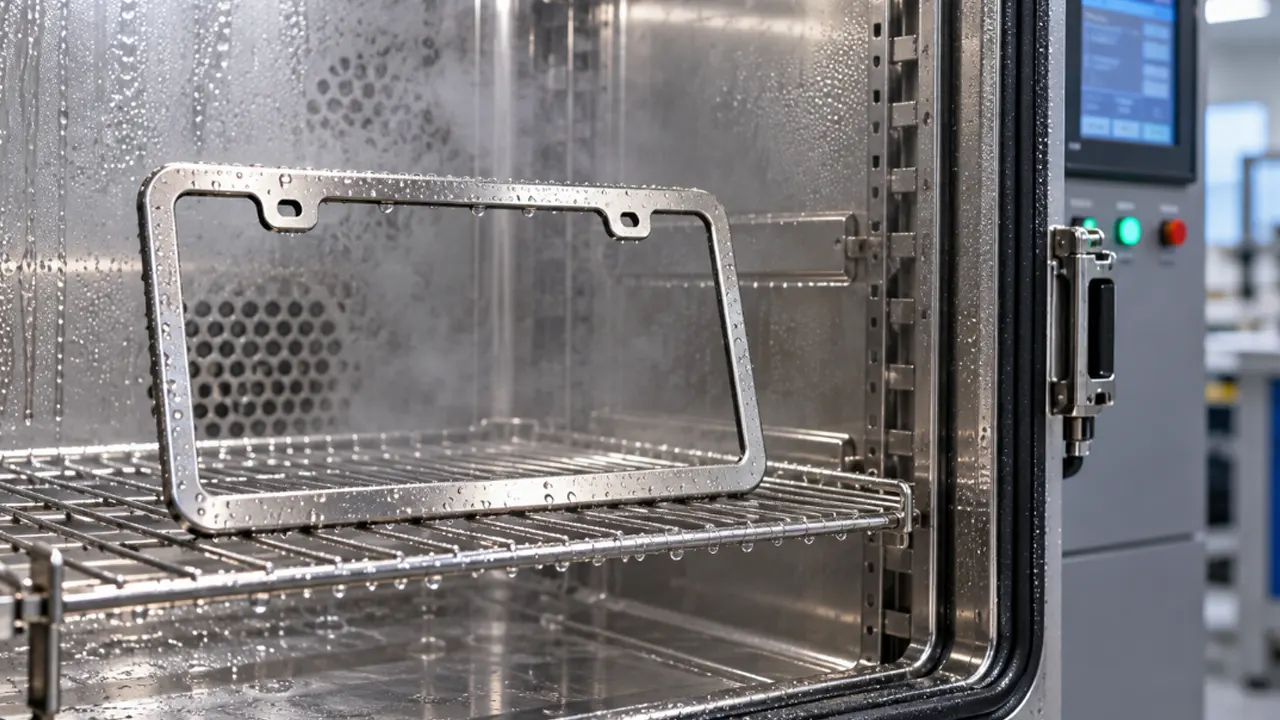
A license plate frame humidity resistance test exposes a finished sample to controlled moisture and temperature, then checks for blistering, corrosion, discoloration, adhesion loss, dimensional change, and damage around edges or fasteners. The first decision is whether the requirement calls for steady high humidity without condensation or cyclic humidity that can create condensation.
Those conditions stress a finish differently. A report that gives only “high humidity for 48 hours” leaves out the chamber temperature, relative humidity, condensation state, cycle, sample orientation, recovery, and acceptance criteria needed to interpret the result.
Steady Damp Heat and Cyclic Damp Heat Are Not Interchangeable
Steady damp heat holds a high-humidity environment at a constant temperature for a prescribed period and is commonly used to observe moisture effects without intentional condensation. IEC 60068-2-78 describes this type of test for components and equipment.
Cyclic damp heat changes temperature and humidity in a defined cycle and generally produces condensation on the specimen. IEC 60068-2-30 addresses cyclic damp heat. These are general environmental methods, not automatic license plate frame requirements; use them only when their scope and the customer specification fit the program.
| Condition | Main feature | Potential frame concerns |
|---|---|---|
| Steady high humidity | Constant warm, humid exposure without intended condensation | Moisture uptake, finish change, adhesive or print response |
| Cyclic damp heat | Temperature and humidity cycle with condensation | Crevice moisture, edge corrosion, interface stress, water spotting |
| Salt fog | Saline corrosive atmosphere | Different corrosion mechanism; not a substitute for humidity |
Test the Complete Finished Construction
Humidity can affect the base material, conversion layer, plating, paint, clear coat, ink, adhesive, insert, fastener, and contact between different materials. Use production-representative finished samples when the goal is product qualification. Process coupons can help isolate a coating system, but they may not reproduce edges, recesses, screw holes, or trapped moisture.
Identify color, finish, lot, drawing revision, and any mold cavity or tool position. If the product family uses several decoration methods, do not extend one result to every variant without evidence.
Define Whether the Frame Is Mounted
A free frame exposes all surfaces evenly. An assembled frame creates crevices and contact points similar to installation. The plate, washers, screws, spacers, and bracket can change drainage and galvanic relationships. Choose the configuration from the test objective and document it.
For mounted testing, use a representative plate and support material. Record tightening and orientation. The washer and spacer selection factors help identify places where moisture may be trapped or coating pressure may change.
Control Chamber Conditions and Sample Placement
Record chamber temperature, relative humidity, cycle timing where applicable, exposure duration, ramp or transition conditions, and sample orientation. Space specimens so air can circulate and condensate from one sample cannot drip onto another unless the method allows it.
Do not open the chamber casually for repeated visual checks; it can disturb the environment. If intermediate inspections are required, define their timing and handling in advance.
Inspect the Places Moisture Reaches First
Edges, mounting holes, cutouts, recessed lettering, plating transitions, parting lines, scratches, and fastener contact points often reveal problems before broad flat surfaces. Look for blistering, peeling, staining, white or red corrosion products, color or gloss change, print lifting, swelling, and insert movement.
Map the location and size of each defect. “Corrosion present” is less useful than identifying whether it began at a deliberately scribed area, an unprotected cut edge, a screw contact, or an undamaged face.
Allow the Defined Recovery Before Final Judgment
Some materials temporarily absorb moisture or show surface condensation immediately after exposure. Specify whether inspection occurs wet, immediately after removal, after rinsing, or after recovery at standard conditions. Do not wipe, polish, or clean away evidence unless the procedure describes the cleaning step.
When dimensions or flatness are checked, record the recovery time. This prevents temporary moisture or temperature effects from being confused with permanent change.
Humidity Testing Does Not Replace Salt Spray
High humidity introduces moisture; salt spray adds a saline environment and is commonly used for comparative corrosion testing of metals and coatings. Passing one does not predict the other. Use the salt spray test interpretation when chloride exposure is part of the requirement.
Likewise, humidity does not reproduce UV radiation. If color fade or chalking is the concern, the UV weathering criteria are more direct.
Pair Visual Inspection With the Right Follow-Up
After humidity exposure, a coating adhesion check may reveal weakening that is not obvious by appearance. A dimensional or flatness check may show swelling or permanent distortion. Electrical checks are relevant only if the frame includes a light or other electrical feature and the product specification defines them.
Keep each follow-up method and result separate. Humidity exposure is the conditioning step; the adhesion, dimensional, or functional test supplies another piece of evidence.
What the Report Should Include
- Specimen construction, finish, color, lot, and revision.
- Mounted or free-state configuration and all contact materials.
- Referenced method, chamber setpoints, cycle, duration, and deviations.
- Orientation, spacing, conditioning, and recovery.
- Before-and-after photos under controlled lighting.
- Defect type, location, extent, and measurement where required.
- Follow-up adhesion, dimension, fit, or function results.
- Predefined acceptance criteria and disposition.
Frequently Asked Questions
Is 85°C and 85% RH the standard humidity test for every frame?
No. That condition appears in some industry programs, but it is not a universal license plate frame requirement. Use the severity and duration specified for the product and material system.
Does humidity testing prove corrosion resistance?
It provides evidence under the stated humid condition. Corrosion behavior also depends on salts, pollutants, damage, material contacts, temperature cycling, and service exposure.
Should the sample be scratched before the test?
Only if the agreed method or customer specification requires a scribe. An intentionally damaged specimen answers a different question from an intact-finish specimen.
Can a plastic frame fail a humidity test?
Yes. Plastic may not form red rust, but moisture can affect dimensions, decoration, adhesives, inserts, fasteners, and interfaces. Evaluate the complete construction.