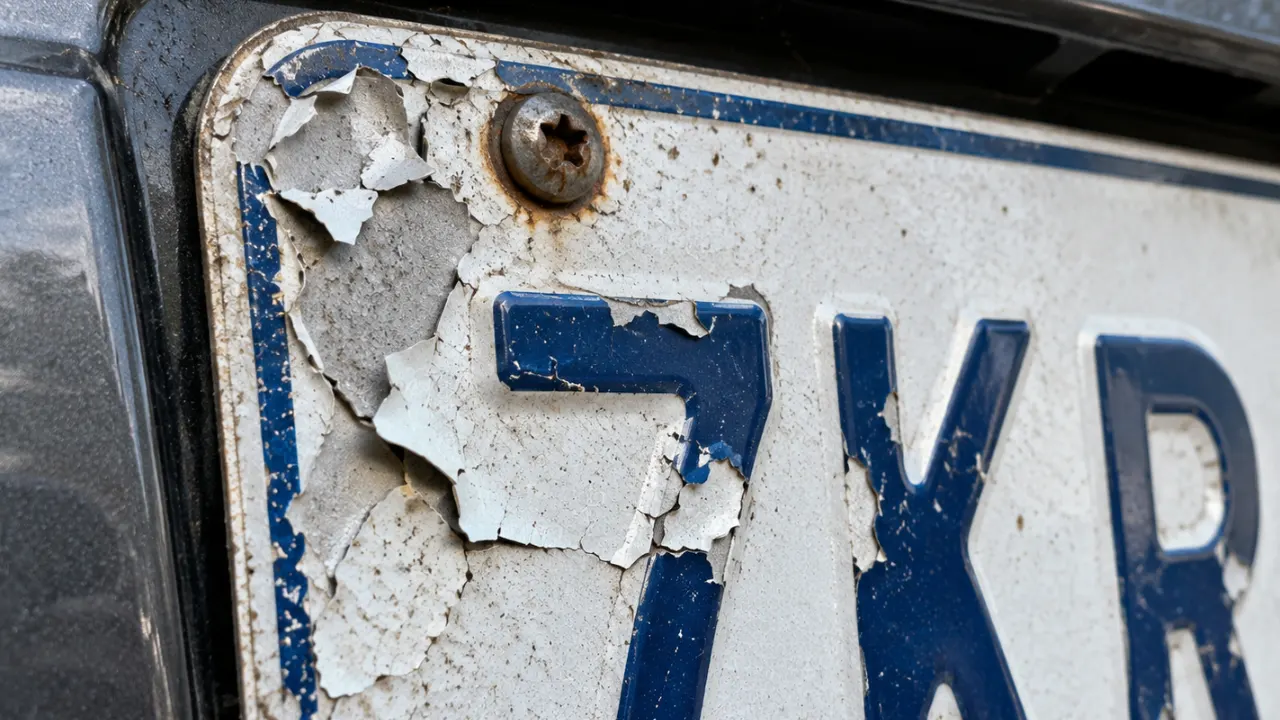
If your license plate is peeling, avoid pulling off the loose material, repainting the numbers, or covering the damage with tape. Photograph the plate and check the replacement procedure from the authority that issued it. A lifting surface layer can affect the plate’s appearance or reflectivity even while some characters remain readable. The right response depends on the plate’s condition and your jurisdiction’s rules.
Start by making sure the problem is actually the plate surface. Dirt, adhesive residue, a peeling registration sticker, and a deteriorating license plate frame can look similar from a distance. Once you identify which part is failing, you can ask for the correct replacement and avoid making a repair that changes official identifying information.
What Does a Peeling License Plate Look Like?
Peeling usually appears as a lifting edge, flaking area, blister, or separated surface layer. You may see the background or printed area curling away from the material underneath. In some cases the damage starts around an edge or mounting hole; in others it spreads across a larger section.
“Delamination” describes layers separating. Plate construction varies, so you cannot identify the exact failed material or cause from the word alone. Some plates use reflective sheeting on a substrate, while other plate types have different construction. What matters for the owner is whether the official surface is lifting, missing, or becoming difficult to identify.
Do not pick at a corner to find out how much will come off. That can enlarge the damage and remove useful evidence of its original condition. Take a clear photograph of the whole plate and a close view of the affected area without bending or scraping it.
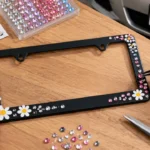
Also inspect the frame separately. A frame’s decorative film, coating, printed lettering, or plating may be peeling while the plate itself remains sound. Replacing a frame does not replace an official plate, and requesting a plate replacement does not repair a worn accessory.
| Appearance | Possible issue | Useful next action |
|---|---|---|
| Loose dirt or road film | Surface contamination | Gentle cleaning according to normal plate care |
| A lifting sheet or missing surface patch | Possible plate delamination | Photograph it and check the issuing authority’s replacement process |
| Localized adhesive around a registration decal | Sticker or adhesive issue | Check registration-sticker instructions before removal |
| Damage only on the surrounding frame | Accessory finish failure | Inspect and replace the frame separately if needed |
| Bent metal, torn holes, or deep scraping | Physical plate damage | Ask about the appropriate damaged-plate replacement route |
| Faded appearance with no loose layer | Aging or another surface issue | Ask the authority whether replacement is required |
Check Readability Without Damaging the Plate
Look at the plate with it mounted normally and the vehicle safely parked. Check the registration characters, issuing state or jurisdiction, validation marks, and any other information your local rules require. Inspect the area that has peeled rather than focusing only on the largest number.
An official plate can have a visibility problem before every character disappears. A missing background layer may change contrast or reflectivity. Blisters can interrupt the view, and a loose flap can move across a character. A plate that looks acceptable at arm’s length is not necessarily acceptable under the issuing authority’s criteria.
Do not invent your own distance test as a universal rule. Pennsylvania, for example, has a stated recognition-distance criterion and also identifies conditions such as peeling and loss of reflectivity. Other jurisdictions can use different wording and processes.
If the lamp is dirty or not working, deal with that as a separate issue. A lighting fault can make an otherwise readable plate appear dark, but repairing the lamp will not restore a missing plate surface. Likewise, cleaning a plate may reveal damage that grime had hidden.
Why License Plates Can Peel
A plate has to withstand outdoor use, but that does not make every surface failure traceable to one cause. Material aging, damage, environmental exposure, or a problem within the plate’s layered construction may contribute. Without the plate’s history and a proper assessment, you cannot reliably decide whether the cause is manufacturing, cleaning, impact, or mounting.
Look for evidence rather than assuming. Has the damage followed a scraping mark? Is it concentrated where an accessory touches? Is the plate distorted around a fastener? Did a loose frame allow repeated movement? These observations are useful when you contact the authority or inspect the mounting.
Weather exposure alone does not establish a defect, and one peeling plate does not prove that every plate of that color or design will fail. Avoid relying on social-media photographs to decide which replacement program applies.
Your immediate task is to preserve legibility and obtain the correct official replacement if needed. Investigating a possible cause can help you avoid unnecessary rubbing or poor mounting when the new plate arrives, but it does not substitute for the issuing authority’s process.
What to Do as Soon as You Notice Peeling
First, leave the damaged surface alone. If the plate is safely secured, photograph it in place before removing any accessory. Capture the complete plate number and a close view of the lifting layer. Keep an unedited copy in case the authority asks for evidence.
Next, find the official website for the authority that issued the plate. Search for damaged, peeling, delaminating, or illegible plates. Those terms may lead to different application routes. A standard replacement for a lost plate may not have the same fee or evidence requirements as a peeling-plate program.
Check whether the application asks for photographs, an in-person assessment, a completed form, or verification by an authorized representative. Confirm whether you want to retain the same registration number. That choice may change the process or fee.
If the plate is already difficult to identify, ask the authority what you may do while replacement is arranged. A pending application is not something you should assume grants a nationwide grace period or permission to drive with an unreadable plate.
Keep a record of the application and follow any temporary-display instructions actually issued to you. Do not make a homemade paper copy or fit a decorative replacement merely because the new official plate has not arrived.
New York: A Specific Peeling-Plate Replacement Process
New York DMV maintains a dedicated peeling-plate process. As checked on October 21, 2026, its instructions distinguish keeping the existing number from receiving the next available standard number.
The DMV describes a no-charge route for the next available standard number and a separate same-number application using Form PP-7 with a $20 fee. It asks for a photograph of the peeling plates and provides different submission instructions for those choices. Apportioned IRP plates have their own route.
Use the current DMV instructions for the exact application method and documents. Do not assume a plate damaged by impact belongs in the same category as coating delamination, and do not use an old forum post as the source for fees or mailing details.
The New York DMV peeling-plate instructions are the place to check before applying. These are New York procedures, not a U.S. replacement policy.
Pennsylvania: Illegible Plate Verification
PennDOT describes a registration plate as illegible when one or more numbers or letters cannot be recognized from 50 feet, or when the plate shows conditions including blistering, peeling, discoloration, or loss of reflectivity.
Its current replacement instructions use Form MV-46. The owner completes the relevant sections and obtains verification from a law enforcement officer, certified inspection station, or authorized Online Messenger, then submits the completed request for a free replacement.
That verification step matters. You should not assume a photograph and an online payment complete the process in Pennsylvania just because another state uses an online or email application.
Check the PennDOT illegible registration plate instructions for the current form and submission requirements. Do not apply Pennsylvania’s distance criterion or free-replacement process to a plate issued elsewhere.
If Your Plate Was Issued Somewhere Else
Use the plate’s issuing state, province, territory, or country rather than the location where you bought the vehicle. The dealership and the registration authority serve different roles. A dealer may help you find the process, but the authority determines how an official plate is replaced.
Look for a dedicated deteriorated-plate program before selecting a generic duplicate-plate service. Confirm what the authority considers a defect, ordinary damage, or an illegible plate. Eligibility can depend on plate type and the actual condition.
Ask whether both plates must be replaced if only one is affected. Check what happens to your number, registration document, and validation sticker. Personalized, specialty, commercial, motorcycle, trailer, and apportioned plates may not all use the same procedure.
If you cannot identify the right route, describe the problem precisely: a surface layer is separating, the number is still partly visible, or an edge is missing. “My plate looks old” gives the service representative much less information.
Avoid publishing personal registration documents or your complete application in a public discussion while seeking help. Send required evidence through the authority’s official channel.
Information to Have Ready Before You Apply
Have your registration details and plate number available. Check that your name and address are current, because replacement plates and documents may be mailed. Use the authority’s process to correct an address rather than assuming a note on a damaged-plate form will update every record.
Prepare clear photographs if requested. A full view identifies the plate; a close-up shows the damage. Avoid glare, filters, or a frame obscuring the affected area. Keep the originals in case a compressed upload is difficult to assess.
Read the current form before signing it. Some applications require third-party verification or a specific signature. An incomplete submission may delay the replacement even when the plate clearly needs attention.
Save confirmation messages and copies of submitted forms in a private place. Note whether the authority gave you further instructions about driving, displaying temporary documentation, or disposing of the old plate.
If you are applying for a family member, leased vehicle, fleet, or company vehicle, check who is authorized to request the replacement. The person who drives the car is not always the registered owner.
Can You Repaint, Glue, Tape, or Clear-Coat a Peeling Plate?
Do not try to recreate the plate’s official surface with household paint, markers, glue, clear coat, or reflective tape. Those materials do not restore the original issuing specification and can change the appearance of characters, background, or validation details.
Glue can also make a later assessment harder. Pressing a loose film back into place may conceal the visible symptom without restoring its bond or optical behavior. A visually neat patch does not establish that the plate remains compliant.
Clear tape adds another layer over the plate and may alter glare, collect dirt, or cover details. A transparent shield is a separate accessory subject to local rules. It should not be used to hide a failing plate or presented as an official repair.
If you want to preserve an old plate as a keepsake after replacement, first follow the issuing authority’s surrender or disposal directions. A display project is a different question from maintaining the active plate on a road vehicle.
When uncertain, ask about an official replacement rather than trying to make the damaged surface look new. Keep the plate as received until you have documented it and received the relevant instructions.
Cleaning a Plate That Has Started to Lift
Treat loose surface material gently. Do not pressure-wash a lifting edge, scrub it with a stiff brush, or pull off flakes to make cleaning easier. Avoid abrasive pads and aggressive solvents.
If dirt prevents you from documenting the damage, ask the authority whether an uncleaned photograph is sufficient. Where gentle washing is appropriate, use mild automotive soap, water, and a soft cloth without rubbing the loose layer. Stop if the surface begins to detach.
Let the plate dry without scraping water out of a blister or seam. Do not use heat to flatten the surface. The aim is to inspect and document the condition, not to force the layers back together.
The normal approach to cleaning a license plate assumes the surface can tolerate gentle washing. Once material is lifting, use more caution and prioritize replacement guidance.
A clean plate may still be defective or illegible. Cleaning is useful for removing contamination; it does not reverse delamination.
Inspect the Frame and Mounting Without Blaming Them Automatically
When the plate is removed according to the replacement process, inspect the license plate frame, fasteners, bracket, and contact points. Look for burrs, sharp edges, trapped grit, worn contact marks, or a plate bent against an uneven support.
Those findings can suggest rubbing or stress, but they do not prove that the frame caused a layered surface to fail. Keep the distinction between an observation and a diagnosis. If you see widespread peeling away from all contact points, changing the frame alone is unlikely to address the plate itself.
A properly fitted frame should leave the required plate information visible and should not force the plate into a distorted shape. Check the opening, hole alignment, vehicle recess, and fastener engagement. Overtightening cannot correct a wrong size.
A frame may also hide an early lifting edge from casual view. Remove it for inspection only when you can do so safely and without interfering with the official application instructions. Support the plate rather than allowing it to bend as the final screw comes out.
If you choose a replacement frame, use the license plate frame size guide to identify the relevant measurements. No frame material can be promised to repair or prevent every plate delamination problem.
Installing the Official Replacement Plate
Compare the new plate number and associated documents with the authority’s instructions. If the number has changed, identify services tied to the old one, such as toll accounts, parking permits, or access systems. Update them through their own procedures.
Inspect the bracket before installation. Replace damaged hardware with the correct type and length. Do not use a longer screw simply because a new frame adds thickness; check available engagement and clearance behind the mounting point.
Align the plate without bending it to meet a mismatched frame or bracket. Start each fastener by hand, follow the vehicle’s mounting instructions, and tighten evenly. Keep any required stickers and jurisdiction details visible.
Check the plate lamps and the view of the installed plate. A wide frame or projecting decorative feature may hide an area that was visible before. A successful replacement includes a sound mounting arrangement, not just a new sheet of material.
After normal use, inspect for movement or rubbing. Correct a loose bracket or damaged contact point if found. This is ordinary installation care; it should not be described as a guarantee against future surface failure.
What to Do With the Old Peeling Plate
Follow the issuing authority’s instructions about return, destruction, or recycling. Do not assume all states require surrender, and do not assume keeping a plate is allowed simply because another state permits it.
Wait until the replacement process tells you when the old plate is no longer needed. Destroying it too early may remove evidence or leave you without the display the authority expects while the request is processed.
Keep reusable frames and suitable hardware separate from the official plate. A frame is an accessory and often does not need to be discarded with a deteriorated plate. Inspect it for damage before reusing it.
If you are interested in recycling or retaining an old plate, the options depend on its registration status and local requirements. The broader discussion of what to do with old license plates can help you organize those questions.
Make Sure You Are Requesting the Right Kind of Replacement
A peeling surface is different from an entire plate that is missing. If a plate has fallen off or may have been stolen, use the authority’s lost-or-stolen procedure rather than assuming a deteriorated-plate program applies. Tell the authority whether the physical plate is still in your possession.
A registration sticker also has its own status. If only the validation decal is lifting, ask about a replacement decal and preserve the surrounding plate surface. Do not remove official markings to make the application photograph look cleaner.
If damage appears to involve deliberate alteration or someone has changed the registration characters, describe that separately. Do not trace over the number to restore its appearance or try to reproduce a missing letter. The authority needs to know what actually happened.
When you make contact, a clear description helps: the plate is present and firmly mounted, its background layer is lifting at one corner, or a character is partly missing. Combine that description with the photographs and registration information requested. It helps the service representative direct you to the appropriate form without treating every damaged-looking plate as the same problem.
Frequently Asked Questions
Is peeling always a manufacturing defect?
No. A photograph alone may not establish the cause. Damage, aging, mounting contact, or a problem within the layered construction may be involved. Let the issuing authority decide which replacement category applies.
Can I keep the same number?
Sometimes. It depends on the authority, plate type, and replacement route. New York currently has a separate same-number application, while other jurisdictions use different processes.
Do I need to replace a plate if only the background peels?
Ask the issuing authority. Characters can remain visible while background damage affects contrast or reflectivity. Do not use the condition of the number alone as your only test.
Will a new frame stop the peeling?
A frame cannot restore a failed surface layer. Correcting rubbing or poor fit may address a contact problem, but it does not repair existing delamination or guarantee that the plate will not peel.
Is a peeling registration sticker the same problem?
No. A registration decal and the plate’s main surface can have different replacement procedures. Identify which layer is lifting before removing anything or applying for a replacement.
Does applying for a replacement make the old plate acceptable to drive with?
Do not assume it does. Ask the authority about the plate’s current condition and any temporary-display instructions. Application confirmation is not a universal exemption from display requirements.