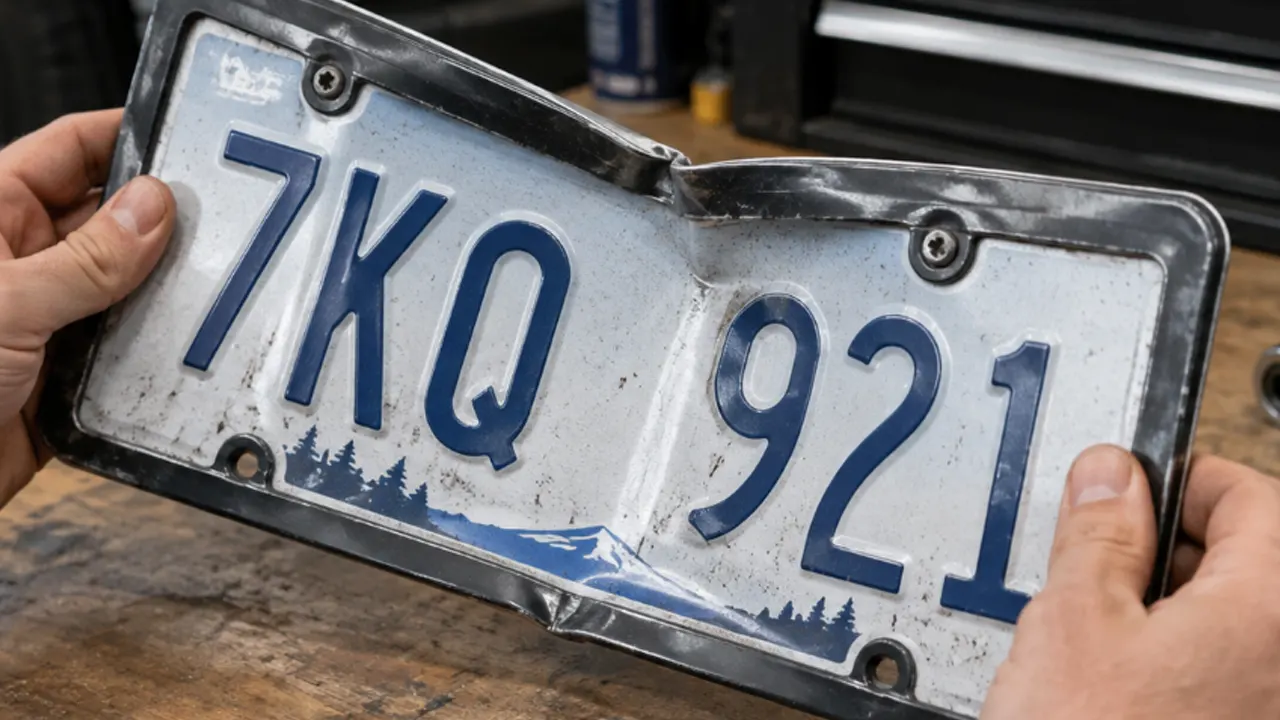
A slightly bent metal license plate can sometimes be flattened with slow, even pressure, but only when the characters, reflective face, registration stickers, mounting holes, and edges remain intact. A sharp crease, cracked surface, torn hole, peeling reflective layer, or unreadable detail is a replacement problem—not a reason to press harder.
Look at the cause before you fix the shape. If a loose screw, warped frame, uneven bumper recess, or unsupported corner bent the plate once, reinstalling it the same way will bend it again. Major impact damage also deserves a closer look at the bracket and bumper behind the plate.
Check the Damage Before You Try to Straighten It
Remove dirt and inspect the plate in good light. You are deciding whether the problem is a gentle bow, a damaged surface, or a failed mounting point. These are not the same repair.
| Damage Level | What It Looks Like | Best Next Step |
|---|---|---|
| Minor bend | A shallow bow or one curled edge; all printed or embossed details remain clear; no surface cracking | Gentle flattening may be reasonable if the issuing authority does not require replacement |
| Moderate damage | A visible bend near a mounting hole, distorted border, or a crease beginning to form | Remove the plate and inspect both faces; replace it if the hole, coating, sticker, or character area is affected |
| Severe damage | A sharp fold, torn metal, cracked or peeling face, distorted characters, or a plate that no longer sits securely | Stop trying to reshape it and request a replacement from the issuing authority |
View the plate straight on and from both sides. A bend may turn one character away from the viewer or throw glare across the reflective face. Check the stickers as carefully as the main characters.
Why Do License Plates Bend?
Low-speed parking contact. A front plate that projects from the bumper can meet another bumper, a wall, a parking stop, or a shopping cart before the vehicle body does. At the rear, cargo, a hitch accessory, or someone leaning against an unsupported plate can curl an edge.
Automatic car washes. A brush or cloth strip can catch a projecting plate or frame, especially when a corner is loose or the bracket flexes.
Road and trail debris. Gravel, compacted snow, branches, and off-road obstacles can curl a low-mounted plate before bumper damage becomes obvious.
Loose or missing fasteners. One secure screw and one loose screw create a hinge. Airflow and vibration let the unsupported side move repeatedly, enlarging the hole or flexing the same line until the plate stays bent. A separate explanation of why plate-frame screws loosen can help you correct the cause before reinstalling anything.
An uneven mounting surface. Tightening a flat plate against a curved bumper recess, raised boss, trapped cable, or mispositioned spacer can pull the plate into a bow. The bend may appear gradually as the screws are tightened, even though the plate was flat in your hand.
Overtightening. A screw head or washer can dish the area around a mounting hole. Tightening one side fully before starting the other can also twist the plate or frame across the mounting plane.
A damaged or mismatched frame. A frame that is already twisted can force the plate to follow its shape. A frame opening or hole layout that does not match the plate may concentrate pressure at the corners instead of supporting the border.
Can You Straighten a Bent License Plate?
Sometimes. A shallow bend with an intact surface is different from a crease that has permanently stretched the metal. The more localized and sharp the bend, the less likely it is to return to a flat shape without leaving a ridge or damaging the face.
A minor bow is the best candidate for gentle correction. The pressure can be spread over a wide area, and you can stop as soon as the plate lies flat enough to mount without stress.
A moderate bend needs caution. If it passes through a character, sticker, embossed area, or mounting hole, replacement is often the more sensible choice. Pressing the plate flat may hide the shape problem while leaving a weakened hole or fractured surface.
A severe crease should not be treated as a routine DIY repair. Metal that has folded sharply may crack when reversed, and a reflective or printed layer can split even when the base metal seems to move. The goal is not cosmetic perfection; it is a secure, legible, officially valid plate.
Plate construction varies by jurisdiction and plate type, so do not assume every plate will respond the same way to pressure.
How to Straighten a Slightly Bent License Plate
Use this method only for a gentle bow or curled edge with no cracking, peeling, torn holes, damaged sticker, or distorted registration detail. If your state motor vehicle agency treats any physical damage as grounds for replacement, follow that process instead.
- Photograph the installed plate. Take a straight-on view and both sides to record the damage and surrounding mount.
- Remove the frame and plate. Park safely, keep the fasteners together, and support the plate while loosening the final screw. If a screw is seized or the head is stripping, stop before the screwdriver slips across the plate or paint.
- Clean off loose grit. Use mild soap and water, then dry with a soft cloth. Grit can scratch the face or hide cracks.
- Inspect both sides. Check holes, characters, reflective film, and sticker edges. Stop if the metal or surface layer is splitting.
- Use a flat, padded surface. Place the plate face up between clean, smooth padding on a rigid flat surface. A folded microfiber towel or clean felt can protect the front, but make sure there is no grit in the fabric.
- Apply slow, broad pressure. Press with both hands over a wide area rather than forcing the high point with a thumb. Work gradually from the outer portion of the bend toward the center. Stop often and lift the plate to inspect it.
- Stop when the plate mounts without stress. Do not keep flexing it back and forth to chase a perfectly flat cosmetic result. Repeated bending can weaken the metal and may damage the surface.
- Check the mount before reinstalling. Put the frame alone against the vehicle and see whether it sits flat. Then hold the plate in place without screws. If either part rocks or bows, correct the bracket, spacer, or mounting surface first.
- Reinstall evenly. Start every screw by hand. Bring them down in small, alternating turns until the plate and frame are secure. They should not rattle, but the screw heads should not dish the plate.
- Make a final visibility check. Step back and view the plate from the center and both sides in daylight. Confirm that the characters, state name, stickers, and any other required information remain visible.
The removal and reinstallation steps in a standard plate-frame installation sequence can help if your vehicle uses ordinary screw mounting. Vehicle-specific brackets and hidden fasteners may require their own instructions.
What You Should Not Do to a Bent Plate
- Do not strike it with a hammer or mallet. Concentrated impact can flatten embossed details, crack the reflective face, or create new dents.
- Do not use aggressive heat. A heat gun, torch, oven, or boiling-water method can affect films, inks, adhesives, stickers, and coatings before the metal looks different.
- Do not grind, sand, polish, or scrape the face. The plate’s reflective and printed surfaces are functional identification features, not automotive paint to be refinished.
- Do not clamp a sharp crease flat. Strong localized force may make the plate look straighter while splitting the surface or tearing a weakened hole.
- Do not drill new holes without official and vehicle-specific guidance. A new hole may alter the plate, damage a character or coating, create a stress point, or fail to match the vehicle’s approved mounting position.
- Do not repaint or redraw damaged characters. Contact the issuing authority when identification details are damaged or faded.
- Do not bend it repeatedly by hand. Back-and-forth flexing can turn a shallow bend into a fatigue line or crack.
Can You Bend a License Plate Back by Hand?
A very slight edge curl may move with hand pressure, but bare-hand bending is hard to control. Fingers concentrate force into small areas, and one quick correction can overshoot the flat position. A clean, padded, flat surface spreads the load more evenly.
If you use your hands, support the plate close to the bend and move it only a little. Never twist opposite sides. Stop at a crack, new surface line, lifting sticker, or softened fold. Once the plate sits against a flat mount without force, do not keep flexing it.
When Should a Bent Plate Be Replaced?
Request a replacement when the damage affects identification, surface integrity, or secure mounting. Common replacement signs include:
- one or more characters are distorted, obscured, or hard to recognize;
- a registration sticker is torn, peeling, missing, or no longer readable;
- the reflective face is cracked, blistered, peeling, delaminating, or badly scraped;
- the metal has a sharp crease, split, or crack;
- a mounting hole is stretched, torn, or no longer holds the plate securely;
- the plate cannot sit flat enough to display clearly after a gentle attempt;
- the plate was damaged in a collision and the bracket or bumper is also distorted; or
- your issuing agency requires replacement for the type of damage present.
Replacement rules and procedures are not uniform across the United States. California DMV, for example, tells vehicle owners to replace plates and registration stickers immediately when they are damaged or made illegible. Pennsylvania publishes its own illegibility criteria and replacement process. Those examples are useful, but neither is a nationwide rule. Check the agency that issued your plate, especially if you have a personalized, specialty, disability, commercial, or historic plate.
Do not throw the old plate away until you know what the issuing authority requires. Some processes require surrender, cancellation, documentation, or specific handling of the damaged plate and stickers.
Does a Bent License Plate Affect Visibility?
It can. A flat plate presents all characters and reflective areas on roughly the same plane. A bend turns part of that plane away from the viewer and changes how light reaches it. At night, one section may appear brighter or darker from a particular angle even though the plate looks acceptable in a garage.
A curled edge can also hide the state name or a registration sticker from an off-center view. A wide frame may compound the problem if its border follows the bend or covers information near the edge. Cameras and human observers do not view the plate from one identical position, so a straight-on check alone is not enough.
A home camera test cannot decide legality; distance, angle, exposure, motion, dirt, and plate design all change the image. Follow the issuing authority’s current rules, then check that the installed plate is clean, secure, and readable from ordinary angles.
Can a License Plate Frame Prevent Bending?
A frame can add edge support and help a plate stay flatter, but it cannot prevent damage from a strong impact. It also cannot correct a bent bracket, an uneven bumper surface, or the wrong mounting geometry.
Support depends on the whole structure:
- Perimeter coverage. A frame that supports more of the outside edge may reduce free movement at the corners, provided the opening does not cover required plate information.
- Frame cross-section. Rail width, thickness, ribs, bends, and material all influence stiffness. The material name by itself does not tell you how supportive a frame will be.
- Fastener layout. Four properly aligned mounting points generally control more corners than two, but only when the plate, frame, bracket, and vehicle actually provide those mounting points.
- Flat backing. A rigid frame attached to a curved or damaged bracket can still force the plate into a bow.
- Washers and spacers. Correctly sized hardware can distribute load or bridge a designed gap. The wrong spacer can introduce tilt, reduce thread engagement, or concentrate stress.
Compare the frame opening, outside size, hole positions, and vehicle recess rather than choosing by appearance alone. The practical differences between slim and fuller-border frame designs include both visible coverage and the amount of structure around the plate.
Which Frame Materials Can Support a Plate?
No material is automatically the “best” support. Geometry, thickness, mounting points, manufacturing method, and how the frame contacts the plate matter as much as the material label.
| Frame Type | General Character | What to Check |
|---|---|---|
| Stainless steel | Can provide a rigid metal border in an appropriate design | Grade, thickness, formed edges, hole layout, finish, and contact points are model-specific |
| Aluminum | Lightweight metal option that can add edge support without much mass | Section shape, thickness, finish, flatness, and mounting geometry determine the result |
| Plastic | Lightweight and available in many molded structures | Resin, ribs, wall thickness, temperature exposure, and screw-boss design vary by model |
| Slimline | Keeps visual coverage low and may help preserve edge visibility | A narrow border may offer less support than a deeper rail, but actual stiffness depends on the complete design |
If support is your priority, compare real frame drawings or samples rather than assuming that every stainless steel frame, aluminum frame, or plastic frame behaves the same way. A poorly supported metal strip can twist, while a well-ribbed molded frame can hold its shape effectively in its intended application.
Loose Screws Can Make the Bend Return
A plate that rattles is moving. That movement may be small, but the same unsupported corner can flex thousands of times during normal driving. The hole may elongate, the frame may rub the plate, and a small curl can become permanent.
Check whether the screw is loose or the insert behind it is spinning, stripped, or missing. The screw head must overlap the hole and any washer must sit flat. An overlong screw may bottom out before clamping the plate.
If the assembly is noisy even when the screws are snug, inspect the contact points described in license plate frame rattle diagnosis. Foam, washers, or spacers should solve a known gap or vibration path—not hide a warped plate.
Bent Plate or Bent Frame?
Remove the parts and place them separately on a known flat surface. That simple test prevents you from bending a good plate to match a damaged frame.
| Symptom | Plate May Be at Fault | Frame May Be at Fault | Check Next |
|---|---|---|---|
| One edge lifts on a flat table | Yes | Yes | Test each part separately with no screws |
| Assembly bows only on the vehicle | Possible | Possible | Bracket, bumper recess, spacers, or screw depth |
| Hole is elongated or torn | Yes | Possible | Fastener alignment and clamp area |
| Frame corner is cracked or twisted | No, unless impact transferred | Yes | Replace the damaged frame and inspect the plate face |
| Characters or reflective face are damaged | Yes | May have caused rubbing | Issuing-authority replacement requirements |
| Both parts lie flat off the vehicle | Less likely | Less likely | Vehicle mounting surface and hardware |
The plate and frame can usually be replaced separately. The exception is when the mounting system combines a carrier, bracket, frame, clips, or hidden fasteners into one vehicle-specific assembly. Identify the part before ordering a replacement.
Install the Plate So It Does Not Bend Again
Start every screw before tightening any of them. This keeps the plate and frame free to align naturally. If a screw will not start by hand, the hole or thread is misaligned; forcing it can pull the assembly sideways.
Tighten in small alternating turns. Stop when the assembly is secure and no longer rattles. Overtightening can dish the hole area, distort a plastic frame, compress an uneven spacer, or bow the plate against a curved surface.
Support the corners appropriately. Use the mounting points the vehicle and frame are designed to use. Do not add holes to the official plate simply because an unsupported corner moves. If a designed gap needs correction, the washer and spacer selection process helps you think through load distribution, screw engagement, and surface contact.
Keep the frame clear of required information. A fuller border may add structure, but coverage and support are different questions. The plate still needs a suitable opening around its characters, state name, stickers, and other required details.
Recheck after the first drives and wash. Look for movement, fresh rub marks, a loosening screw, or an edge beginning to curl. Catching the mounting problem early is easier than straightening the plate again.
Can a Front Plate Bend More Easily?
A front plate is often more exposed to parking contact, brush washes, road debris, snow, and curb-height obstacles. Some vehicles also place the front plate on a small bracket that projects from the bumper rather than inside a protected recess. That does not mean every front plate will bend, but the installation deserves a closer look if the problem keeps returning.
Check bracket rigidity, ground clearance, bumper curvature, cooling openings, sensors, and camera clearance. Do not improvise a new position without checking local display rules and vehicle guidance. If there is no factory-drilled location, compare front plate mounting methods that avoid drilling the bumper.
After a front impact, look beyond the plate. A cracked bracket, pulled insert, damaged bumper tab, blocked sensor, or shifted camera may not be obvious until the new plate is installed.
Frequently Asked Questions
Is it legal to drive with a bent license plate?
There is no single nationwide answer. Requirements vary by jurisdiction, and the important issue is often whether the plate is securely displayed and whether its characters, stickers, state identification, and reflective surface remain readable. If the bend affects required information, check the current rule and replacement process of the issuing authority rather than relying on a general online answer.
Can you flatten an aluminum license plate?
A shallow bow in an intact aluminum plate may respond to slow, broad pressure on a padded flat surface. Stop if you see a crease, crack, coating damage, torn hole, or distorted character. Also confirm that your issuing authority does not require replacement for the damage present.
Can bending damage the reflective coating?
Yes. A sharp bend can stretch, crack, wrinkle, or separate a surface layer even when the base metal does not break. Inspect the plate in angled daylight after any gentle flattening attempt; a new line, blister, or peeling edge is a reason to stop.
Does a license plate frame prevent bending?
A suitable frame can support the perimeter and reduce movement, but it cannot stop major impact damage. Support depends on frame geometry, mounting points, hardware, and the surface behind the plate—not just the material name.
Why does my license plate keep bending?
Repeated bending usually means the cause remains. Look for a loose corner, brush-wash contact, a flexible or twisted bracket, a curved mounting surface, missing spacer, overtightened screw, or a plate that projects into a common impact area.
Can I drill new holes in a bent plate?
Do not drill an official plate as a casual repair. New holes can damage its surface or identifiers, weaken the metal, and conflict with issuing-authority requirements. Fix the vehicle-side bracket or obtain the correct mounting hardware; ask the issuing agency if the plate itself needs replacement.
Should I replace a badly bent plate?
Yes when the bend creates a sharp crease, damages a character or sticker, cracks or peels the reflective face, tears a mounting hole, or prevents secure and readable display. Follow the replacement process for the authority that issued it.
Can a bent plate damage a frame?
It can. Pulling a bent plate flat with the frame screws may twist a thin frame, stress molded corners, or keep one rail under constant load. Test both pieces separately on a flat surface and replace the damaged part rather than forcing one to straighten the other.
Can I keep driving while waiting for a replacement?
Check with the issuing authority. Temporary permits, proof requirements, surrender rules, and replacement timing vary. Do not assume that an application receipt lets you display an unreadable, insecure, or altered plate.
Fix the Cause, Not Only the Shape
A shallow bend may be corrected gently when the plate remains intact, but creases, torn holes, damaged stickers, peeling surfaces, and unreadable details call for replacement. Before reinstalling, test the plate, frame, bracket, and vehicle mounting surface separately. The part that bends the plate is often behind it.
If a new frame is part of the solution, compare the real plate format, opening, hole positions, vehicle recess, and border coverage before choosing. A frame can add useful edge support, but only a correct installation keeps the plate flat, secure, and visible.