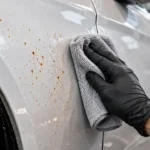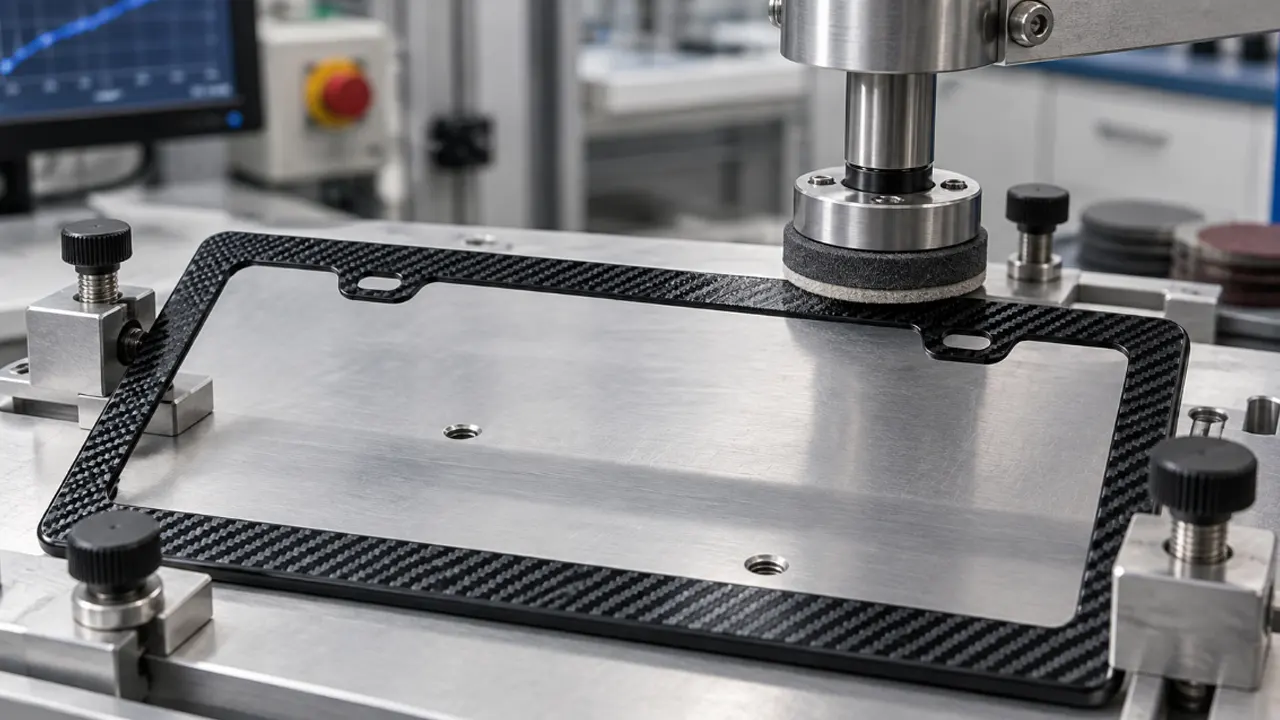
A license plate frame abrasion resistance test should reproduce the wear you care about and produce a measurable endpoint. A rotating abraser on a flat coating coupon, a controlled rub on printed lettering, and a grit-contact test on an installed frame answer different questions. Choose the method from the finish construction and failure mode before you choose the number of cycles.
“Passed an abrasion test” is incomplete without the wheel or rubbing medium, load, cycle count, specimen preparation, cleaning interval, conditioning, and acceptance rule. Those details can change the result dramatically.
First Identify the Surface Being Tested
A frame may combine base material, primer, paint or plating, clear coat, printed graphics, raised lettering, and localized decoration. The layer at risk determines the method.
| Surface or feature | Likely wear concern | Useful evaluation |
|---|---|---|
| Painted or powder-coated bar | Coating wear-through, gloss loss, color change | Controlled abrasive exposure on a suitable specimen |
| Printed logo or text | Ink removal, edge wear, loss of legibility | Defined rub medium, pressure, stroke, and endpoint |
| Plated or metallic-look finish | Top-layer wear and base exposure | Method compatible with the layer system and geometry |
| Anodized aluminum | Loss of the anodic surface under wear | An anodic-coating method when its scope matches the sample |
| Frame-to-plate contact area | Fretting or scratching from trapped grit | Assembly-specific movement and contamination test |
Abrasion is not the same as adhesion. A coating can bond well to the substrate yet wear rapidly, or resist rubbing but peel from a poorly prepared surface. Use the existing coating adhesion test framework when bond failure is the real concern.
Choose a Standard Only When Its Scope Fits
ASTM D4060 covers abrasion resistance of organic coatings on a plane, rigid surface using a Taber Abraser. That makes it useful for appropriate flat coated panels or suitably prepared flat frame sections, but a complete curved, flexible, or raised-letter frame may not sit correctly in the apparatus.
ASTM B1023 addresses hard anodic coatings on plane, rigid aluminum or aluminum-alloy surfaces with a Taber-type abraser. It is not a generic method for every aluminum finish. If the finished geometry cannot be tested within the method, a representative coupon can support process comparison, while the finished frame still needs a separate appearance and functional evaluation.
Define the Specimen So Results Can Be Compared
State whether you are testing a finished frame, a cut section, or a process coupon. A coupon should use the same substrate preparation, layer stack, cure, color, and production process as the part it represents. Mark the test face and avoid areas with molded texture or geometry that the selected method cannot handle consistently.
Use an untested control sample from the same production condition. Record coating thickness or other relevant construction data when it is part of the approved specification. Do not infer an exact layer system from appearance alone.
Control the Abrader, Load, Motion, and Cleaning
For a wheel-based method, identify wheel type, applied load, number of cycles, resurfacing or replacement practice, dust removal, and specimen rotation. For a linear rub, define the rubbing material, wet or dry condition, normal force, stroke length, rate, direction, and whether one back-and-forth movement counts as one cycle or two.
Cleaning can remove loose debris, but an aggressive cleaner can also change the coating. State what is used between readings and at final evaluation. If solvents are involved, treat chemical resistance as a separate variable unless the method deliberately combines them.
Use an Endpoint That Matches the Product Risk
Possible endpoints include mass loss, wear index, coating breakthrough, substrate exposure, gloss change, color difference, print legibility, or a visual rating against an approved sample. Not every endpoint suits every finish.
Printed dealer text may need to remain readable after the agreed rub exposure. A matte coating may show polishing before it loses material. A bright plated surface may lose appearance well before a thickness measurement becomes informative. Define the pass/fail rule before seeing the result.
Inspect High-Wear Areas on the Finished Frame
Even when a standard coupon supplies comparable lab data, inspect the real frame at mounting holes, inner corners, raised letters, bottom bars, and packaging contact points. Washers and screw heads can abrade a finish during installation. Grit trapped between the plate and frame can create a different wear path from a laboratory wheel.
The article on washers and spacers helps identify contact pressure and movement around mounting holes, while the metal-frame packing method addresses abrasion that begins before installation.
Combine Abrasion With Weathering Carefully
UV exposure, humidity, temperature cycling, or salt can weaken a finish before rubbing. A combined sequence may be useful when it reflects the product requirement, but it should not be confused with a single abrasion test. Record the order of exposure because abrasion-before-weathering and weathering-before-abrasion can produce different failure patterns.
For outdoor finish evaluation, the UV weathering test considerations cover irradiance, cycle, color, gloss, and cracking. Keep the separate results visible even when the program includes a combined sequence.
What the Test Report Should Include
- Part, finish, color, lot, and drawing or specification revision.
- Finished part, section, or process-coupon identity.
- Referenced method and any deviations.
- Abrader or rubbing medium, load, cycles, speed, direction, and cleaning.
- Conditioning and any prior environmental exposure.
- Initial and final measurements or ratings.
- Photos under controlled lighting and the exact failure location.
- Predefined acceptance criteria and final disposition.
Frequently Asked Questions
How many abrasion cycles should a license plate frame pass?
There is no universal number. Cycle count only has meaning with the method, abrader, load, specimen, and agreed endpoint. Set the severity from the customer requirement or a validated comparison program.
Can I test the full frame in a Taber Abraser?
Only if the specimen geometry and mounting comply with the chosen method. A curved, flexible, or raised frame may require a representative coupon plus a separate finished-part test.
Does abrasion resistance predict years of outdoor life?
No. It measures wear under stated conditions. Outdoor life also depends on UV, moisture, temperature, chemicals, road grit, installation, cleaning, and the complete finish system.
Is a thumb rub an acceptable test?
It can be a quick screen, but hand pressure, speed, skin condition, and cycle count vary too much for strong comparison. Use a controlled method for acceptance data.