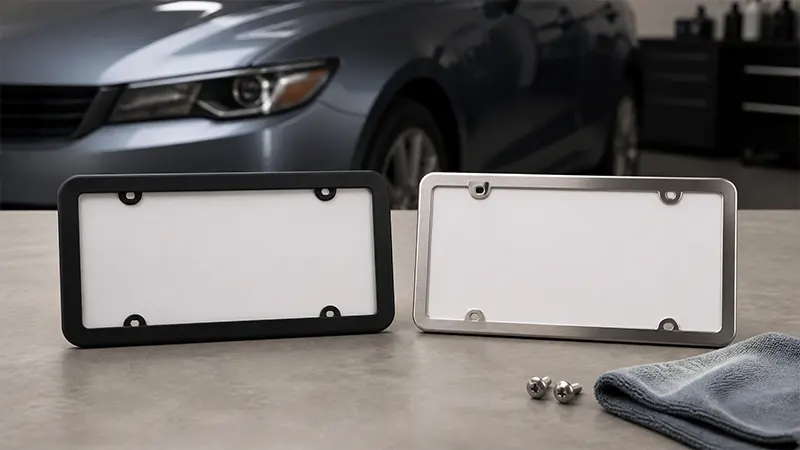
Choose silicone when your priorities are rattle control, soft contact around the plate, and a low-key appearance. Choose metal when you want a thin rigid border, sharper decorative detail, or a polished, brushed, anodized, painted, or plated finish. Neither material is automatically better: a poor silicone design can trap grit and water, while a poor metal frame can rattle, corrode at damaged areas, or mark paint.
Silicone vs Metal at a Glance
| Decision factor | Silicone frame | Metal frame |
|---|---|---|
| Noise control | Soft channel can isolate the plate edge and reduce contact noise | Needs correct flatness, support, washers, or pads to prevent vibration |
| Paint contact | Soft surface is forgiving, but trapped grit can still abrade paint | Rigid edges need smoothing and isolation from the vehicle finish |
| Appearance | Minimal, matte, flexible surround | Crisp profile with premium metallic and decorative options |
| Branding | Usually subtle molded or printed branding | Supports printing, laser marking, embossing, casting, plating, and emblems |
| Corrosion | Body cannot form iron rust; screws and plate can still corrode | Behavior depends on alloy, finish, cut edges, and hardware |
| Cleaning | Remove periodically to clear grit from the channel and rear face | Use finish-compatible cleaner and dry around screws and edges |
| Fit | Channel, stretch, drainage, and plate thickness must match | Opening, outer envelope, hole pattern, and flatness must match |
| Typical failure | Tearing, loose corners, distortion, staining, or trapped debris | Rattle, burrs, bent borders, finish damage, pitting, or plating failure |
Where Silicone Has the Advantage
Silicone separates the sharp plate edge from the vehicle and dampens small movements. That makes it appealing when a two-screw rear plate taps against a hatch or trunk lid. It also covers the plate perimeter, so you are less likely to catch a bare plate edge while washing the car.
The body itself contains no iron and cannot produce red iron rust. That does not make the complete assembly corrosion-proof. Steel screws, a damaged plate edge, metal inserts, and the vehicle bracket may still corrode. Water retained behind the plate can make those problems worse, which is why drainage is not a minor feature.
Silicone also keeps the visual treatment simple. If you want the plate to sit within a dark, understated border without a bright reflective surface, the material does that naturally. See the silicone frame category for this construction style.
Where Metal Has the Advantage
Metal creates a sharper, more controlled border. Stainless steel can deliver a polished or brushed face, aluminum supports light weight and many colored finishes, and die-cast zinc alloy allows deep logos and sculpted surfaces. That range makes metal much more flexible for dealer branding, premium accessories, promotional programs, and custom visual themes.
A correctly formed metal frame also holds a precise opening without stretching around the plate. Thin metal sections can look refined while leaving plate information visible. For projects where logo relief, crisp edge definition, plating, engraving, or a durable printed panel matters, metal usually offers the stronger starting platform.
Metal is not one category with one performance level. Compare stainless steel, aluminum, and zinc alloy separately. Our material selection guide explains how substrate and finish work together.
Rattle: Silicone Helps, but Diagnose First
A silicone surround can solve plate-on-body tapping, but it will not tighten a loose bracket or repair broken trim. Before replacing the frame, hold the plate while closing the hatch or playing the audio system at the level that triggers the noise. If the sound stops, inspect the lower plate corners, screw seating, bracket, and frame contact points. If it continues, the noise may be inside the hatch or bumper.
With a metal frame, rattle commonly comes from two upper screws leaving the lower edge unsupported, a warped frame, mismatched screw heads, missing washers, or hard contact between the plate and body. Use pads only at stable contact points and keep them away from drainage paths. Do not add so much soft material that the screws never seat securely.
For a full diagnosis, use our license plate frame rattle guide.
Paint Protection: Soft Is Not the Same as Maintenance-Free
Silicone feels safer against paint, and it usually is more forgiving than a bare metal edge. However, dust and sand can migrate behind any frame. When the assembly moves, that grit acts like an abrasive. A tight channel that retains dirty water can also leave stains on the plate or the painted recess.
A metal frame should have deburred edges, rounded corners, and a clean rear face. Soft washers or isolation pads can prevent direct contact. During installation, keep the frame square and tighten screws evenly by hand. A frame that is forced flat by excessive screw torque can put its corners into the paint.
Drainage and Weather Exposure
Look for clear drainage at the lowest installed points of a silicone frame. Drain holes should remain open after the plate is inserted, not collapse under stretch or become hidden against the bumper. The channel should grip the plate without creating folds that hold water.
For metal frames, inspect cut edges, holes, plating transitions, recesses, and attached emblems. Those are common locations for coating damage or trapped moisture. Stainless hardware is often a sensible choice, but confirm thread type and consider isolation where dissimilar metals contact each other in salty conditions.
Cleaning and Appearance Over Time
Wash either frame with water, a pH-neutral automotive shampoo, and a soft cloth or wash mitt. Rinse away grit before wiping. Avoid abrasive pads, harsh acid or alkaline wheel cleaners, and metal polish unless the finish supplier specifically permits it.
Remove a silicone frame periodically so you can clean the channel, rear face, plate edge, and vehicle surface. On a metal frame, dry around screws, caps, emblems, and lower edges. If a polished or plated surface is scratched, do not assume aggressive polishing is safe; it may remove a thin decorative or protective layer.
Fit and Legal Visibility
Silicone frames can look slim but still creep over a state name or registration tab if the channel is thick or the plate does not seat fully. Metal frames can create the same problem when the border is too wide. Install the complete assembly, then inspect every required plate element from straight on and at normal viewing angles.
Check the vehicle recess, lamp, rear camera, sensors, and hatch handle. A compliant opening on a loose plate does not guarantee a compliant installation on the vehicle. State rules vary, so confirm current official requirements before use; our license plate frame legality overview explains the general design principle.
Which One Should You Choose?
Choose silicone if: your main problem is a plate edge touching the vehicle, you prefer a quiet understated surround, and you are willing to remove it occasionally for cleaning.
Choose stainless steel if: you want a slim, rigid metallic frame with a polished, brushed, painted, or coated finish and clean decorative edges.
Choose aluminum if: low mass, colored finishes, or printed branding are priorities and the alloy and finish are properly specified.
Choose die-cast zinc alloy if: your design needs raised lettering, recessed colors, emblems, or a substantial sculpted appearance.
For a branded product line, the choice should also reflect order volume, artwork, packaging, test requirements, and target markets. Send those details through the custom project form so the frame construction can be matched to the application.
Frequently Asked Questions
Are silicone license plate frames better than metal?
They are better for soft contact and noise isolation. Metal is better for rigid geometry and a wider range of premium finishes and branding methods. Your priority decides the answer.
Do silicone license plate frames trap water?
They can if the channel has poor drainage, fits loosely, or is installed with the drain openings blocked. Choose a design with open low points and clean behind it periodically.
Will a metal frame scratch my car?
It can if it has burrs, hard rear contact points, trapped grit, or is bent against the paint. A flat frame, smooth edges, correct hardware, and suitable isolation reduce the risk.
Which type is more rust resistant?
A silicone body cannot rust, but the plate and hardware can. Stainless steel and aluminum do not behave like bare carbon steel, yet grades, finishes, cut edges, contamination, and hardware still determine corrosion performance.
Can silicone and metal frames use the same screws?
Sometimes, but thickness and recess depth change the required screw length. Match the screw thread and length to the vehicle mount, confirm sufficient engagement, and make sure the screw does not bottom out.